
Desktop PCB Cleaner
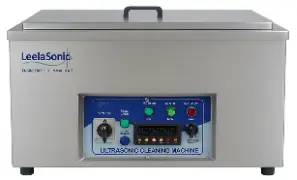
Production / Service Use
Key Features (PCB Cleaning + Flux Removal)
- Flux Removal / Defluxing: Removes rosin flux and soldering contamination (process dependent for no-clean).
- Safe for SMDs: Non-contact cleaning reaches under SMD components and tight gaps.
- Repair + Production: Ideal for mobile PCBs, service centers, and electronics manufacturing.
- Heater + Timer: Controlled cleaning cycles for repeatable results.
Technical Specifications
| Capacity Options | 2L, 4L, 6.5L, 10L, 20L, 30L |
|---|---|
| Frequency | 33 kHz / 40 kHz (component-safe operation) |
| Tank Material | Stainless Steel 304 (die-pressed tank) |
| Heater | Preset 50°C / Digital control (model dependent) |
| Timer | Digital timer for repeatable cycles |
| Typical Use | Flux removal, oxidation cleaning, dust removal, water-damage restoration |
| Accessories | SS lid + basket (model dependent) |
For stencil cleaning and larger boards, see our Ultrasonic Stencils Cleaner.
Ultrasonic PCB Cleaner Machine
LeelaSonic manufactures Ultrasonic PCB Cleaning Machines in India for safe circuit board cleaning and flux removal (defluxing). These machines are used by electronics repair shops, service centers, and SMT assembly lines for consistent and repeatable cleaning.
Quick Summary (click to expand)
- Capacities: 2L to 30L
- Use cases: mobile repair, SMT assemblies, control cards
- Helps reduce: residues, corrosion risk, intermittent faults
Manual brushing cannot reach contamination trapped under SMDs. Ultrasonic cavitation penetrates micro-gaps and removes flux residues, solder balls, dust, ionic contamination and oxidation that can cause corrosion, leakage current or intermittent faults.
Applications
- Mobile Repair: Cleaning smartphone logic boards after water damage (iPhone/Android).
- SMT Assembly: Post-solder cleaning / defluxing after reflow or hand soldering.
- Rework Stations: Cleaning PCBs before and after component replacement.
- Industrial Electronics: Control cards, PLC boards, driver cards, power electronics boards.
- Preventive Maintenance: Removing dust/oil/flux deposits that cause shorts and corrosion.
- PCB Defluxing Guide: Read PCB defluxing / flux removal application notes
Recommended PCB Cleaning Process
- Pre-check: Remove batteries/speakers where required; follow device-specific safety.
- Cleaning Solution: Use PCB cleaning chemistry suitable for your flux type (rosin/no-clean/water-soluble).
- Ultrasonic Cycle: Short controlled cycles are better than long aggressive runs.
- Rinse: Proper rinsing reduces residues and improves reliability.
- Drying: Complete drying is essential (air knife / warm air / oven as per process).
For production lines and higher throughput, consider a Multi Stage Ultrasonic Cleaning System (wash + rinse + dry).
What a PCB Cleaning Machine Removes
A circuit board that looks clean under normal light can still carry residues that cause field failures months later. An ultrasonic PCB cleaning machine removes contamination that brushing and compressed air cannot reach:
- Rosin flux residue: The sticky amber film left after hand soldering and reflow. It attracts dust and traps moisture against the copper.
- No-clean flux residue: Often left in place, but it must be removed before conformal coating or when boards run in humid or coastal conditions.
- Ionic contamination: Invisible salt residues from flux activators and handling. This is the main cause of dendrite growth, leakage current and intermittent faults.
- Solder balls and splash: Loose spheres that migrate under vibration and short adjacent pads.
- Dust, fibres and machining debris: Common on control cards returned from factory floors.
- Water damage deposits: Mineral scale and corrosion products on boards recovered from flood or spill damage.
- Oxidation: Light tarnish on pads and test points that causes poor probe contact during testing.
How to Choose the Right Size
Tank size is decided by your largest board and your batch quantity — not by budget alone. A tank that is too small forces boards to be cleaned at an angle or in halves, which gives uneven results. Use this as a starting guide:
| Tank | Typical board size | Suited to |
|---|---|---|
| 2L / 4L | Up to ~150 × 150 mm | Mobile logic boards, small repair benches, R&D labs |
| 6.5L | Up to ~250 × 200 mm | Service centres, laptop and TV boards, low-volume rework |
| 10L | Up to ~300 × 250 mm | Control cards, driver cards, small assembly lines |
| 20L / 30L | Up to ~450 × 350 mm | Power electronics, PLC boards, batch cleaning in production |
Leave roughly 25 mm clearance on every side of the board inside the basket. For continuous production volumes, a multi-stage system with separate wash, rinse and dry tanks will give better throughput than a single larger tank.
Frequency Selection for Circuit Board Cleaning
Frequency decides how aggressive the cleaning action is. Lower frequencies produce larger cavitation bubbles and more mechanical energy; higher frequencies produce finer bubbles that penetrate tighter gaps more gently.
- 33 kHz: Stronger action. Suited to heavily contaminated industrial boards, thick conformal residues and older through-hole assemblies.
- 40 kHz: The safer general choice for populated boards. Fine cavitation reaches under BGA and QFN packages without stressing solder joints or fine wire bonds.
For a fuller explanation of how frequency affects cleaning results, see our guide on choosing the right ultrasonic frequency.
Cleaning Chemistry by Flux Type
The wrong chemistry is the most common reason a new machine appears to "not clean properly". Match the solution to the flux actually used on your boards:
| Flux type | Recommended approach |
|---|---|
| Rosin (RA / RMA) | Dedicated defluxing solution or controlled IPA. Warm bath (40–50 °C) improves results significantly. |
| No-clean | Saponifier-based defluxer. Plain water will not lift no-clean residue reliably. |
| Water-soluble (OA) | DI water with mild detergent, followed by a thorough DI rinse. |
| General repair / dust | Mild aqueous cleaner. Avoid strong alkaline solutions on aluminium electrolytic capacitor cans. |
Never use unknown solvents in an ultrasonic tank without checking flash point. If you are unsure which chemistry suits your process, send us your flux datasheet and we will advise before you buy.
Industries Using Our PCB Cleaning Machines
- Electronics manufacturing (EMS): Post-reflow defluxing before conformal coating or final inspection.
- Mobile and consumer repair: Water-damage recovery and board-level rework.
- Automotive electronics: ECU and sensor board cleaning where ionic cleanliness is specified.
- Industrial automation: PLC cards, drive cards and power modules returned from plant floors.
- Defence, aerospace and medical: Applications where cleanliness testing is part of the release process.
- Educational and research labs: Prototype boards and teaching workshops.
For correct model selection, share PCB size, quantity per batch, contamination type (rosin/no-clean), and your rinse/drying workflow.
Frequently Asked Questions
Yes, when the correct frequency, chemistry and process are used. Ultrasonic cleaning is non-contact and can remove flux and contamination from under SMDs without damaging components.
Use a dedicated PCB cleaning/defluxing solution for best results. IPA can also be used in controlled setups. The correct chemistry depends on flux type and your rinse/drying workflow.
Yes. Proper rinsing and complete drying improves reliability, reduces residues and avoids corrosion risks.
Yes. "PCB cleaning machine", "PCB board cleaning machine" and "circuit board cleaning machine" all describe the same equipment — an ultrasonic tank designed to clean printed circuit boards. PCB simply stands for printed circuit board.
LeelaSonic PCB cleaning machines range from approximately ₹10,000 for a 2L bench model to ₹65,000 for a 30L unit with digital heater and timer. Price depends on tank capacity, heater type and accessories. As the manufacturer we supply factory-direct, without distributor margin.
Populated boards clean safely at 40 kHz with correct cycle times. However, remove batteries, speakers, microphones, unsealed relays and display assemblies before cleaning, as these are not designed for immersion. Keep cycles short — repeated 2–5 minute runs are safer and more effective than one long run.
Most PCB cleaning cycles run 3 to 10 minutes depending on contamination level, plus rinsing and drying. Heavily soiled industrial boards may need two shorter cycles with a fresh solution rather than one extended cycle.
Small stencils can be cleaned in a larger tank, but production stencils are better handled by a dedicated ultrasonic stencil cleaner, which is sized for frames and uses chemistry suited to solder paste and red glue.
Yes. We manufacture at MIDC Dombivli (East), Maharashtra and dispatch across India, including Mumbai, Pune, Bengaluru, Chennai, Hyderabad, Delhi NCR and Ahmedabad. Custom tank sizes and frequencies are built to specification.